Grid-tied solar is required by code to disconnect during outages — even when the sun is out. A battery fixes that. It also stores the kWh Rocky Mountain Power keeps paying you less for. For ten years I told my customers to wait for better tech and pricing. The wait is over. The retrofit pays back — in resilience, and in math.
Adding a battery to existing solar is a retrofit where an electrician installs a home battery (Tesla Powerwall 3, Sigenergy, or EG4) onto your existing rooftop solar system — without replacing your panels or inverter. It works with almost any installer’s solar: Sunrun, Vivint, SunPower, Tesla Solar, Enphase, SolarEdge, or a DIY install. The retrofit adds backup power during outages and lets you self-consume your solar overnight instead of exporting it for $0.05/kWh and buying it back at $0.13/kWh.
Most retrofits use AC coupling: the new battery sits next to your existing inverter and grabs AC power from the panel. Simpler, works with any solar brand. DC coupling (replacing the inverter with a hybrid) is more efficient but only worth it if your existing inverter is end-of-life. Most BYOP retrofits are AC-coupled.
A whole-home battery is a major purchase, and the right number depends on your home. We size the system first, then give you one straight price with everything included — permits, interconnection, install, inspection, app setup. If a rebate applies, we file it and it lands in your account.
For a decade the answer was “wait.” That’s no longer the answer.
Anti-islanding code shuts your inverter off the second the grid drops. Your $30,000 array sits on the roof producing nothing. A battery creates its own AC reference so the panels stay online — and so does your house.
Utah’s export rate keeps falling. We’re heading toward the California outcome — pennies for what you push, full retail for what you pull. A battery captures every kWh at retail value instead of giving it away wholesale.
Modern LFP batteries pack 13–16 kWh in one cabinet. Retrofit playbooks are mature. The technology that wasn’t worth waiting on is here. Add a TOU plan and the ROI clock starts ticking immediately.
Two diagrams — one shows what your house does today, one shows what it does after a retrofit. Same panels. Same inverter. New gateway, new battery, completely different outcome during an outage.
We can tie any existing solar — microinverter, string inverter, or hybrid — into any of the batteries below. The tie-in covers the AC-coupled inverter pairing and the panel re-tap, and it’s included in every retrofit quote.
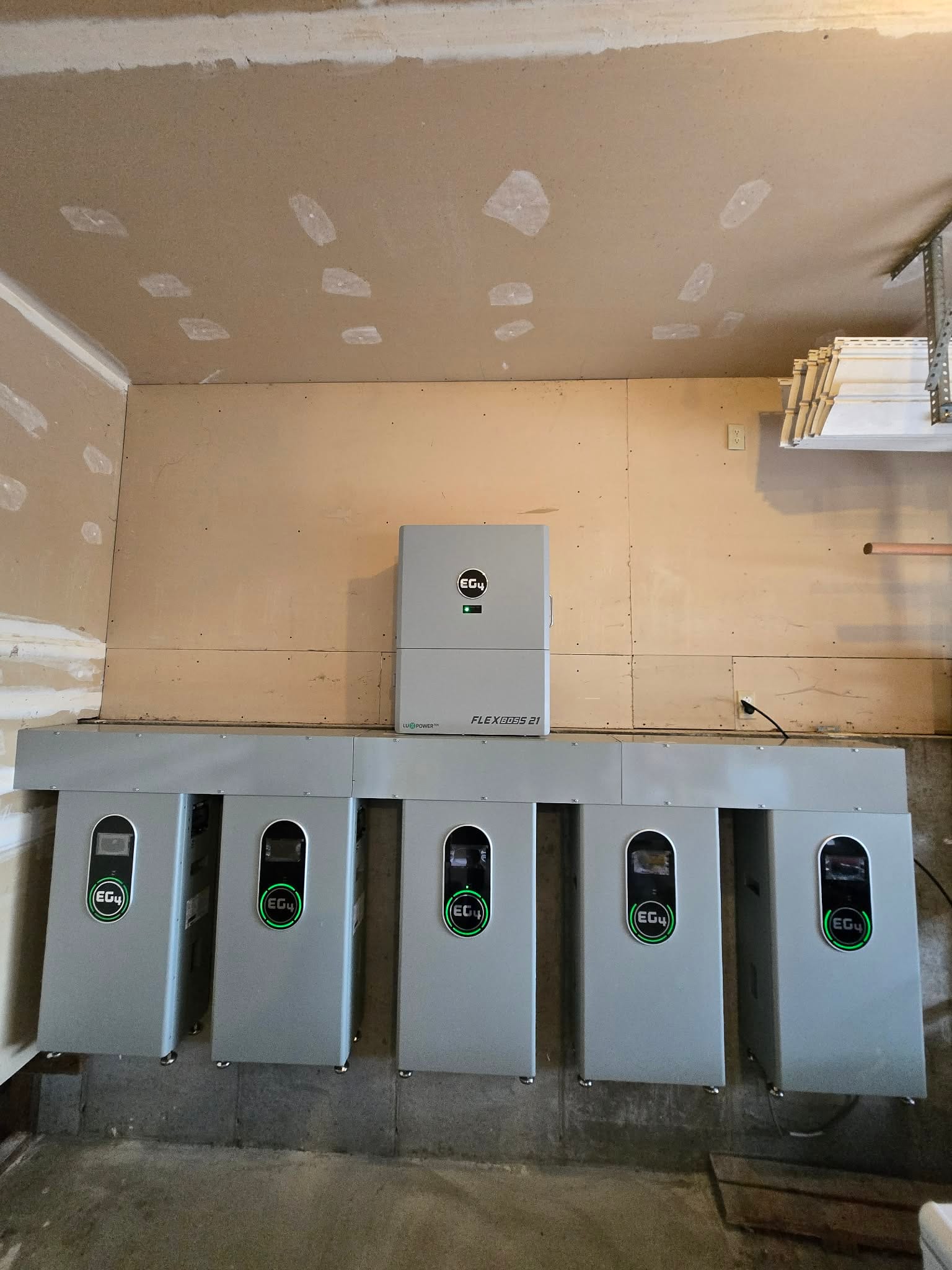
Each one is LFP chemistry, ten-year warranty, Wattsmart-eligible, and compatible with any existing solar — no matter who installed it.
Most installed. The one that earns the rebate stack.
Big existing solar arrays — handles up to 24 kW AC-coupled.
EV owners — V2H turns the car into backup capacity.
A retrofit isn’t a fresh install — we’re bolting onto whatever is already on your wall. There are two extra questions to answer up front. Both get answered during a free site visit.
Modern batteries are big enough to back up your whole home through normal use — including AC and heat pumps if your battery is sized right. The old “critical-loads sub-panel” approach is mostly obsolete. We walk your panel, look at your loads, and confirm whether one battery covers everything or whether you’ll want a stack.
Default position: whole-home backup, no critical-load sub-panel. We only deviate when the math truly calls for it.
We can integrate any existing solar — microinverter, string inverter, or hybrid — into any of the batteries above. The retrofit method depends on your inverter type. AC-coupled is most common (we add a battery-ready inverter alongside what you already own). Hybrid replacement is rare — reserved for older string inverters near end-of-life.
Solar tie-in — the AC-coupled pairing and panel re-tap — is included in every retrofit quote.
We pick the right one based on what’s already on your wall. Here’s how they differ.
Most common. Least disruptive. Keeps your original inverter running.
Cleaner long-term. Required only when the existing string inverter is at end-of-life.
Without a battery, RMP’s Time-of-Use plan is a tax — you pay peak rates for using power when you need it most. With a battery, TOU flips into your favor. You charge from solar when sun is free, then discharge during peak hours so you never see a peak-rate kWh.
Your panels produce more than the house uses. Instead of exporting at $0.05/kWh wholesale, every excess kWh goes into the battery at zero cost.
3pm–10pm is the most expensive window on a TOU plan. Your battery covers the entire peak window from solar you stored hours ago. Nothing comes from the grid.
If your battery isn’t fully charged by sundown, top it off from the grid at off-peak rates (~$0.07/kWh) instead of paying $0.11+ during peak hours the next morning.
Stacking a battery with TOU typically adds another 10–20% on top of base battery savings. We help enroll you in RMP’s TOU plan during commissioning if it pencils out for your usage.
Tell us about your home. We’ll size the retrofit and show the configuration each brand needs at that capacity. Final number requires a panel check — this is the napkin math.
Many retrofit customers don’t realize Rocky Mountain Power’s Wattsmart rebate applies to any new battery enrolled in the program — not just new solar+battery installs. Adding a battery to existing solar qualifies. The rebate comes off your project cost, not into our pocket. Program rules change June 15, 2026 — enrollments before then lock in the current $2,000.
Quick answers. If yours isn’t here, call or text (385) 283-7904.
It’s required by code. Grid-tied solar inverters have anti-islanding protection that disconnects them from your house the moment they lose grid frequency reference. Without that, your panels would back-feed the grid and electrocute the lineman trying to fix the outage. The fix is a battery — the battery’s inverter creates its own AC waveform, your solar inverter syncs to that instead of the grid, and your panels keep producing through the entire outage.
Two things shifted at once. First, Rocky Mountain Power’s net-metering credits keep dropping — Utah is heading toward the California outcome where exports earn pennies and imports cost dimes. Without storage you give power away cheap and buy it back expensive. Second, the technology and pricing finally caught up. For years I told my own customers to wait. The wait is over.
Yes. We retrofit batteries onto systems from any installer — Sunrun, Vivint, Blue Raven, Auric, ES Solar, Momentum, Legend, Tesla Solar, DIY systems, and any out-of-business installer. We don’t care who built it. We care that the retrofit works correctly and passes inspection.
A whole-home battery is a major purchase, and the right number depends on your home. We size the system first, then give you one straight price with everything included — permits, interconnection, install, inspection, app setup. If a rebate applies, we file it and it lands in your account. Tying existing solar into the battery is included in the quote. Rocky Mountain Power’s Wattsmart program pays a flat $2,000 per system on qualifying batteries — rules change June 15, 2026; enrollments before then lock in the current $2,000.
On a TOU plan, electricity costs more during peak hours (typically 3pm–10pm) and less off-peak. With a battery, you charge from solar at midday for free, discharge during peak hours so you never pay peak rates, and re-charge from cheap off-peak grid power overnight if needed. Without a battery, TOU is a tax. With a battery, it’s an arbitrage. The combination usually adds another 10–20% on top of standard battery savings.
Not in most cases. AC-coupled retrofits sit downstream of your existing inverter and panels — your original equipment warranty stays untouched. If your system uses a proprietary hybrid inverter that we’d need to swap, we review the manufacturer’s terms before you commit.
Even better — there’s no warranty interaction to worry about. We see a lot of systems from out-of-business installers (Legend, pre-Sunrun Vivint, Pink Energy, etc.). We document the system condition, engineer the retrofit, and become your point of contact going forward.
Physical install is typically 1–2 days. Full timeline from signed quote to commissioned battery is 4–8 weeks, mostly permitting and utility interconnection review. We file all the paperwork — permits, Wattsmart enrollment, PTO — so you don’t chase anything.
No salespeople. No pressure. Just a straight number on what it’ll cost to add backup to the solar you already own — and how fast the retrofit pays back.
